STORY BY Dawn Tolbert
Photography by Brant Sanderlin
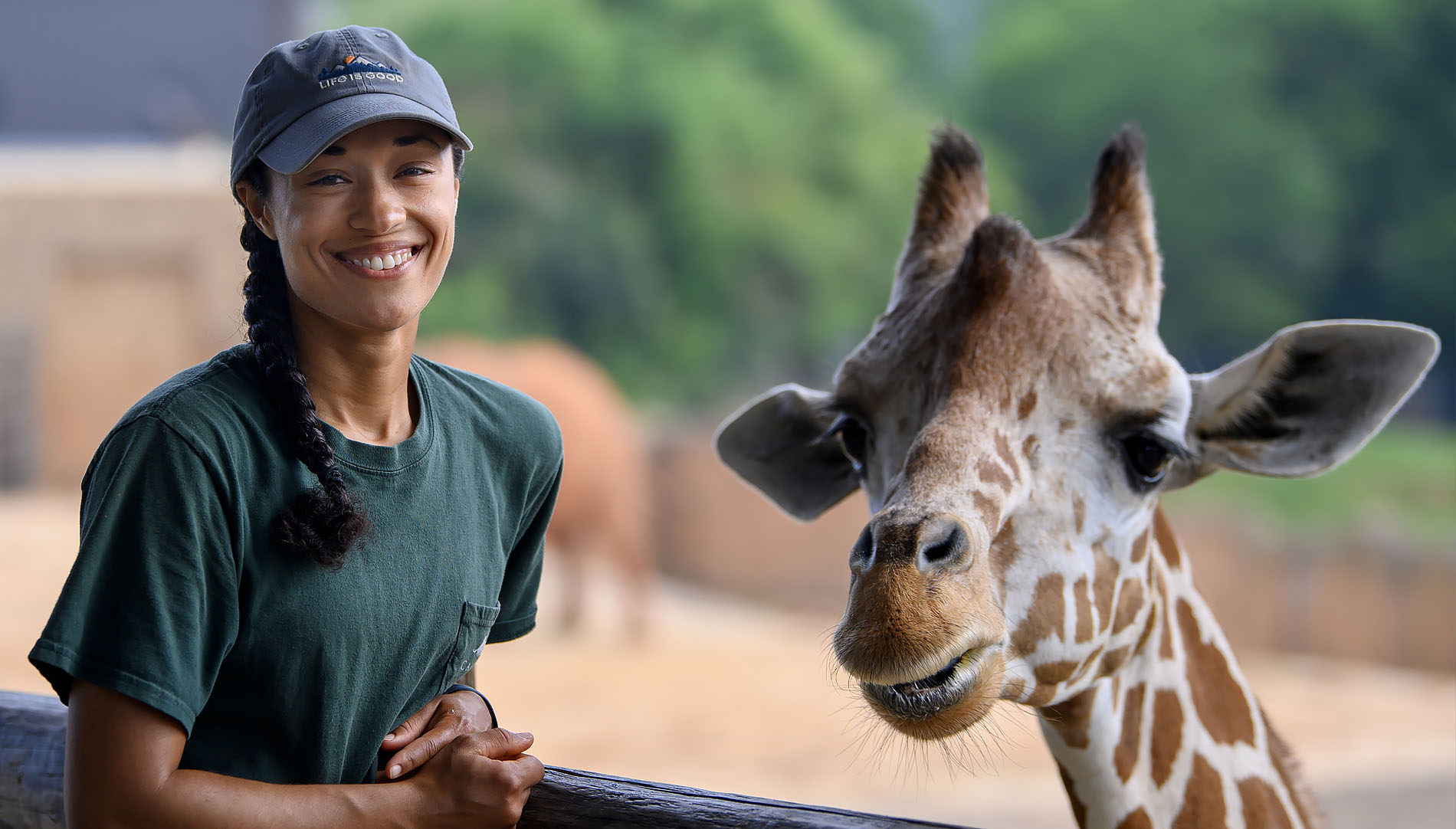
Kara Moss (16C) arrived at Berry dreaming of a career working with animals. Guidance from faculty mentors helped her discover the perfect path. Now she finds joy and purpose in encounters large and small with elephants, giraffes, cheetahs and even a rhino – all part of her daily responsibilities as senior mammals keeper at a Texas zoo.
Amid the off-kilter days of the COVID-19 pandemic, the promise of a baby giraffe brought hope to Kara Moss and her colleagues at the Caldwell Zoo in Tyler, Texas. Longtime resident Nyela was nearing her due date, and the staff was cautiously optimistic despite complications with her past pregnancies.
When Xena June arrived weighing just 100 pounds in June 2020, joy quickly gave way to fear.
“Everyone was delighted when she was born,” Moss reflected. “She was kind of underweight, but we thought she was going to be all right. Then she stopped nursing.”
While the world grappled with a global crisis, the Berry animal science alum found herself fighting a more personal battle: helping the fragile calf survive.
Intensive Care
The weeks that followed were consumed by an all-hands-on-deck effort to save the calf even as the daily responsibilities of looking after the other animals continued. For Moss, who first came to Caldwell in January 2017, those duties included playing a key role in the care of three elephants, 11 cheetahs, four giraffes and one black rhino – all in addition to the ailing newborn.
Typical days began with the team setting priorities, followed by feeding, cleaning habitats and providing enrichment activities for the animals. The staff also led training sessions to encourage participation in medical procedures such as blood draws, ultrasounds and foot care – all especially important for large animals.
Delivering critical care to Xena June increased the workload exponentially.
“Our goal was to make sure she survived,” Moss stressed. “It was summer in Texas, so we were constantly adjusting to keep her from overheating or getting chilled. It was like we lived at the zoo for a couple of months.”
The increased level of care required Moss and her colleagues to work in shifts, clocking out to return only a few hours later for tube feedings and the near-constant monitoring of temperature and hydration. Zoo staffers often found themselves huddled together over their young charge, mindful that they could be putting their own health at risk.
“Because of the pandemic we weren’t even supposed to be within six feet of each other, but here we were with masks on, practically nose to nose, trying to nurse her and just hoping we would be okay,” she emphasized. “Everything was so uncertain outside the zoo. Coming to work had been our reprieve, but now that was super stressful, too.”
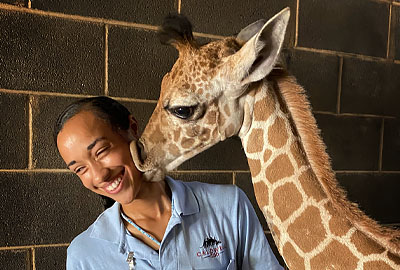
As Xena June (seen kissing Moss in photo at left, photo courtesy of Caldwell Zoo) gained strength, the staff veterinarian directed the team to transition from feeding tube to bottle. The next challenge was keeping up with the not-quite-so-little one’s voracious appetite.
“We tried goat’s milk and other substitutes,” Moss observed. “Eventually something clicked, and she was like, ‘Oh, you know what? A bottle sounds great.’ Turns out she liked cow’s milk – just plain whole milk from the store.”
Keeping the calf sated required a “comical” amount of milk, forcing the zoo’s commissary manager to make three visits to the local Walmart each week, lugging back 10 gallons at a time. The added effort proved worthwhile.
“She defied everyone’s expectations,” Moss declared, beaming. “She got strong, and she got strong fast. She taught us so much about perseverance. Things were crazy, but then you’d see her gain strength. I remember how happy we were watching her take steps without one of us helping. Even the tiniest things were the biggest wins. She helped us through those hard days.”
Step by step
For Moss, helping Xena June was the culmination of a dream dating back to her childhood days in the Los Angeles suburb of Cerritos, California. She adored animals but had to keep her distance due to her father’s severe allergies. Once she was old enough to drive herself, she started working with horses at an equestrian center and became actively involved in caring for friends’ cats and dogs.
The more time she spent with animals, the more she loved it. When it came time to pick a college, she searched for one that offered a strong pre-veterinary program.
“I visited Berry with my dad and fell in love,” Moss shared. “Every other school just kind of fell off the map for me.”
At Berry, she relished engaging in classes, hanging out with friends, wandering miles of trails and indulging at The Sweet Bar, a Rome bakery that still sparks powerful cravings. All the while, she was gaining skills and know-how that one day would benefit Xena June.
“Working at the Berry dairy was a good foundation because, believe it or not, giraffes are just really tall cows,” she quipped. “Everything I learned there about taking care of ruminants carried over to my role here at the zoo.”
Progressing through her coursework, Moss soon realized how little she knew about the career opportunities available in the broader field of animal science.
“It hadn’t even occurred to me that there were options other than being a vet,” she admitted. “Then Dr. [George] Gallagher suggested I consider wildlife rehabbing.”
Following her professor’s recommendation, Moss worked for a summer at the Marine Mammal Care Center in San Pedro, California, as part of a team responsible for aiding in the recovery of sick or injured seals and sea lions.
“Our goal was to rehabilitate, being as minimally hands-on as possible,” she recounted. “We didn’t want them to get used to us because the goal was to release them back into the wild.”
Moss was part of multiple success stories, helping young pups develop hunting skills alongside adults who needed time to recover after being injured by fishing nets or shark bites.
“Most of the time, it didn’t take long for them to regain strength. Then we would take them back to the beach, open that door and just let them run. And they would run!” she exclaimed. “I knew then that I wanted to be outside working with animals.”
Back at Berry, Dr. Sunday Peters, now professor and department chair of animal science, encouraged Moss to explore opportunities with the Association of Zoos and Aquariums, where a paid internship at Caldwell caught her eye. The prospect of starting her career on 80-plus acres inhabited by an incredible array of animals representing areas as diverse as the American wilderness, Amazon River basin, Africa and Asia proved too tempting to pass up, so not long after graduation she set off for the Lone Star State.
Life at the zoo
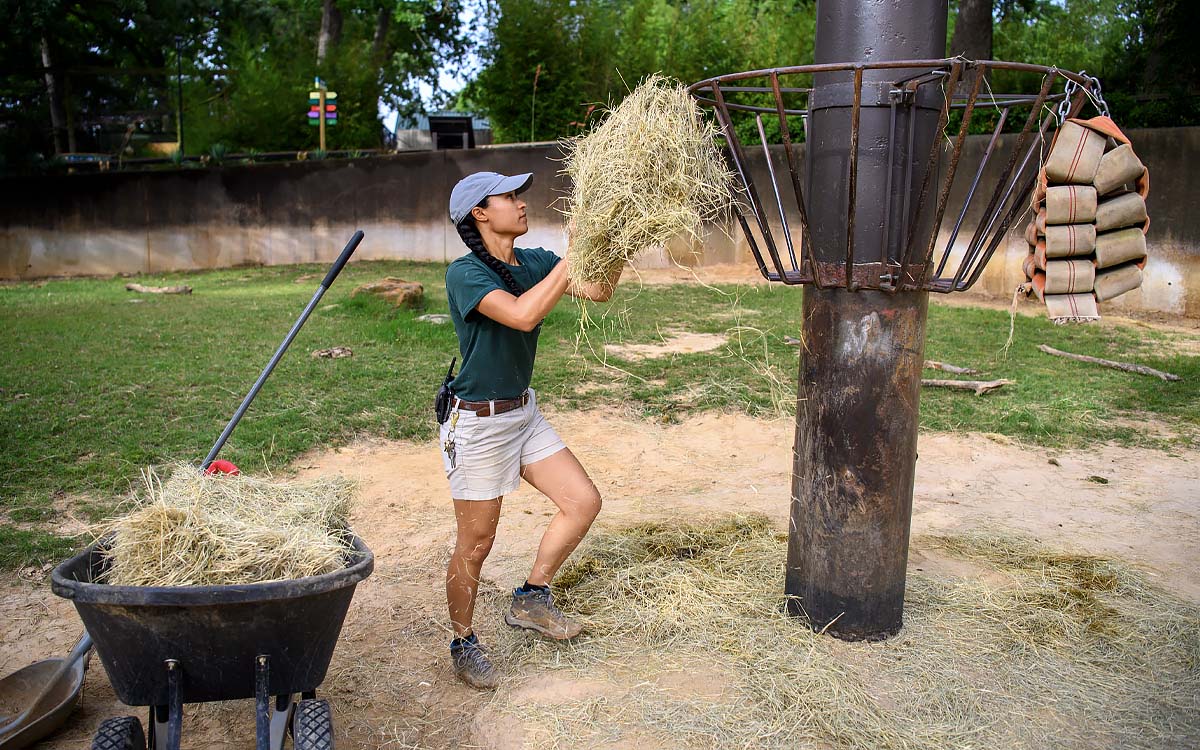
Nearly a decade later, Moss remains at Caldwell, having risen through the ranks from entry-level intern to senior mammals keeper. Through regular interaction including training and enrichment, she relishes being able to develop the kind of deep-seated relationships with her animal charges that only come with time.
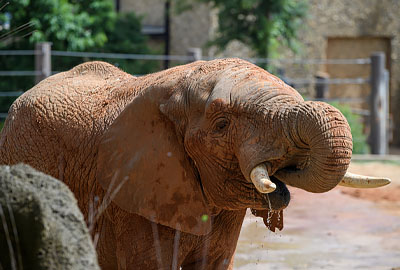
Headlining her cast of characters is Tonya, a 48-year-old African elephant who loves routine and is not shy about sharing that fact.
“She’s got everyone wrapped around her finger,” Moss confided. “If you don’t do things her way, she’ll let you know – sometimes by throwing things.”
A key to keeping Tonya and the other elephants happy and healthy is providing the right “enrichments” – food and other incentives intended to make their environment more stimulating and engaging.
“It might be food items they don’t see every day, like strawberries or watermelons,” Moss explained. “We don’t give them green beans anymore because Tonya hates green beans. I won’t do that again!”
Other enrichments, like puzzle boxes or hay nets, require the elephants to stretch and problem-solve for treats. The staff also creates a variety of substrates in the yard, from mud perfect for wallowing to hills encouraging exercise.
It’s different for the giraffes, who prefer tongue-manipulation puzzles and toys like oversized balls. The cheetahs enjoy remote-controlled cars, feathers and novel scents.
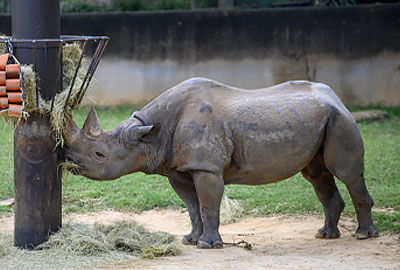
And then there’s Kiano, a 2,400-pound black rhino who loves nuzzling up for a scratch.
“He’s just the best,” Moss gushed. “He’ll come over and hang out with you while you clean. He just wants to be close.”
Kiano retired to Caldwell after siring two calves while living at another zoo and now contributes routine blood samples for a research study aimed at decreasing illness among his species in the wild. He also charms the schoolchildren who visit.
“Not everybody can afford to go to Africa and see these incredible animals firsthand, but if they just come to the zoo for an afternoon, he’s so easy to fall in love with,” Moss praised of Kiano, who is roughly the size of a Subaru. “As you get to know our animals, you understand how great these guys are, not just here, but in the wild.”
Worth preserving
Moss and her menagerie have been featured in news reports and social media posts showcasing the zoo’s work to the broader community. In a recent television interview, she taught a reporter to cut “browse” – fresh, edible plant materials given to the herbivores to provide nutrition and encourage natural foraging behavior. She also enjoys answering questions from families and school groups, seeing each encounter as an important opportunity.
“The unfortunate truth is the animals I work with are not doing well globally,” she warned. “Numbers are going down for giraffes, rhinos and elephants. So, when people come to the zoo and get to see and relate to these animals, it represents more. I hope they will become involved in conservation.”
Moss is pleased to point out that Caldwell actively supports wildlife protection efforts, both through participation in research projects on a national and global scale as well as by contributing a portion of its gate receipts and proceeds from the sale of paintings created by the giraffes and elephants under her care.
“We’re just doing our best to make sure the efforts are successful because we want these animals to thrive,” she concluded. “Navigating this line between human and nature is tough. It’s a full-time job.”
The work is hard, often messy, but Moss wouldn’t have it any other way. Whether tending to the needs of a struggling newborn, a lumbering giant or a lightning-quick feline, she has found purpose for her passion, achieving a level of meaning that’s every bit as sure-footed as Xena June’s no-longer wobbly gait.