STORY BY DAWN TOLBERT
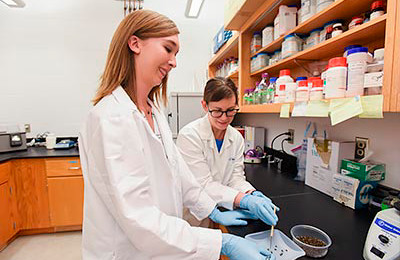
On a busy Wednesday in March, Dr. DeLacy Rhodes called Dr. Madison Barshick (21C) to discuss their work as faculty co-mentors for a team of Berry students preparing for the college’s annual Symposium on Student Scholarship. In reviewing the research before them, both were keenly aware that the topic being explored originally sprung from a question Barshick asked as a Berry student, a true full-circle moment highlighting the potential of undergraduate research to enhance learning outcomes for generations of students, sometimes in service to the same idea.
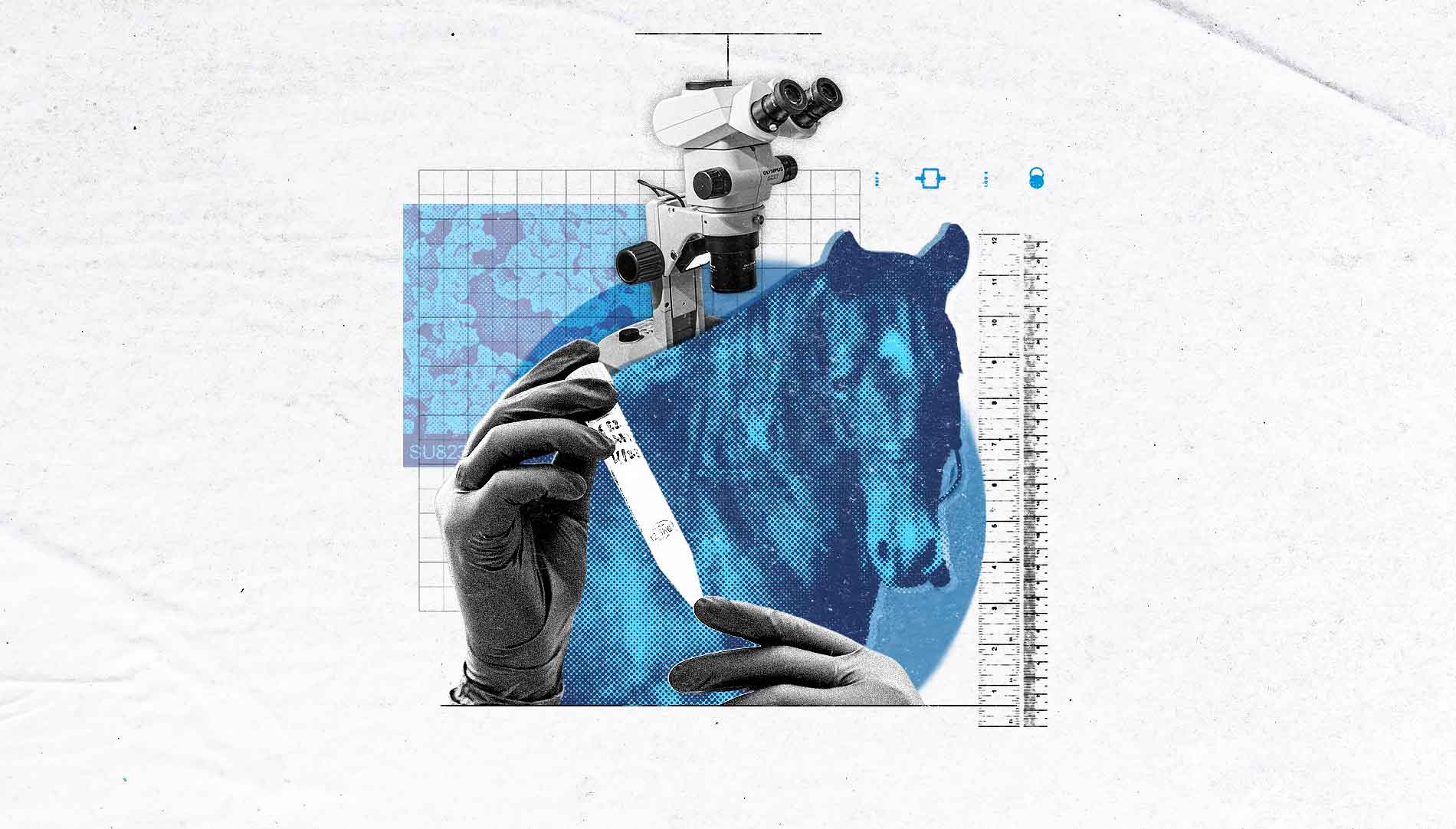
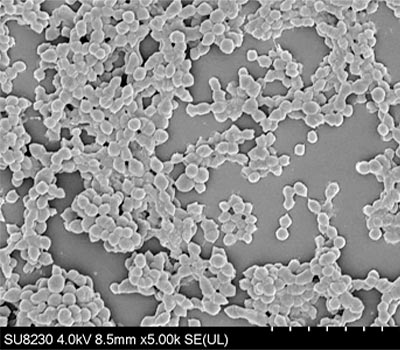
The evolving study focuses on whether the bacteria responsible for a contagious upper-respiratory infection in horses known as strangles disease forms biofilms (clumps of organisms that stick together to evade the host’s defenses and increase antibiotic resistance). Barshick first suggested the possibility in spring 2020 while taking a bacterial pathogenesis class taught by Rhodes. In that moment, the associate professor of biology immediately recognized that her student (and now colleague) had identified “a nice hole in the literature” that no one had studied previously.
Unfortunately, the disruption caused by the on-rushing pandemic prevented them from getting their research study off the ground, though they did partner on a publication discussing the adaptation of a hands-on course to remote learning.
First steps
Rhodes returned to the idea after Barshick graduated with a double major in animal science and biochemistry, securing her former student’s permission before posing the question to biology major Bryce Thomas (23C). Intrigued, he initiated the first experiments to determine whether the Streptococcus equi subspecies equi bacteria did in fact create biofilms, knowledge with potential to improve treatment and prevention of strangles in horses.
“We are investigating a pathogen of significance,” Rhodes emphasized. “Strangles is highly contagious, and anyone who has horses is very concerned about it. We’re figuring out important information about how this organism causes disease. It’s good science, and that’s the kind of research we’re able to do at Berry.
“I love how this project has been influential for so many different undergraduates as they’ve been part of this work,” she added. “Every scientific question that we investigate leads to more questions, so we have a whole thread of research that goes through our lab involving lots of different students.”
Rhodes added that Thomas was only a sophomore when he joined the project, emphasizing that such an early start is not unusual at Berry.
“At larger institutions, it can be hard for an undergraduate to get research experience, but our students have the opportunity to get involved as early as their freshman year, making it possible to gain four years of progressive experience,” she stressed. “In the process, they develop really close relationships with professors and get all the extras like applying for grants and going to conferences – experiences that truly prepare Berry students for graduate school.”
Just look at Barshick, who excelled as a doctoral student in the animal science program at Virginia Tech thanks to the preparation she received at Berry.
The freshly minted Ph.D. returned to her undergraduate alma mater last fall as visiting assistant professor of animal science. This summer, she moved into a tenure-track assistant professorship, excited to extend to others the same type of research opportunities that so benefitted her.
“My goal is to help students understand what it looks like to be a scientist, to plan a project, to write a grant and to run all the tests,” she shared. “The mentorship is continuous as we talk about the data and how to describe it to someone who may not understand the project. I love teaching and conducting research, but the best part for me is mentoring the students and helping them as they try to figure out what life looks like after Berry. Their wins are so much more important than mine at this point.”
Remarkable researchers
The strangles project has become something of a launchpad, propelling multiple Berry students into selective graduate programs.
Thomas is now a Ph.D. student at Vanderbilt University, serving as a research assistant in the cancer biology lab.
Annalie Harris (24C), meanwhile, completed a two-year postbaccalaureate fellowship in the immunopathogenesis section at the National Institute of Allergy and Infectious Diseases this summer and is continuing her studies in immunology through a dual Ph.D. program offered by the University of Pennsylvania and the National Institutes of Health.
And then there’s Hannah Blanton (25C), whose work on the project helped her land a national Goldwater Scholarship, the preeminent award for undergraduate students in science, mathematics, technology and engineering. She is currently a Ph.D. student in microbiology and molecular genetics at Emory University.
Passing the pipette
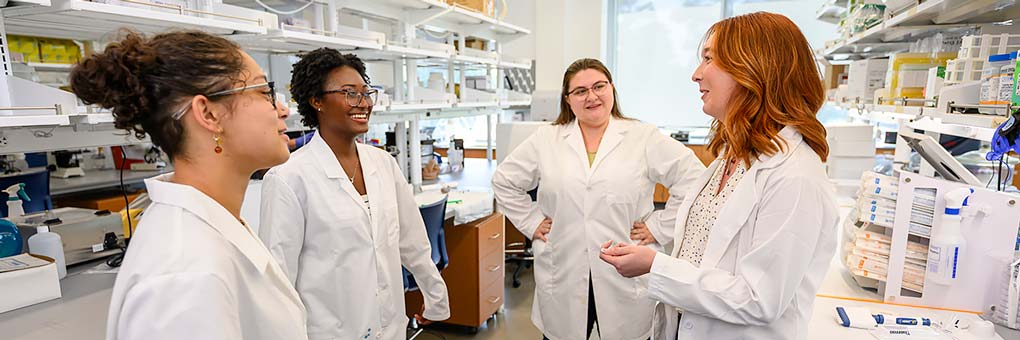
Following in their footsteps are Jazmine Buxton (26C), AbbeyLynn Howard (27c) and Rae Hill (28c), who worked together last spring. Buxton and Howard presented the trio’s findings at the spring symposium, with Howard also serving as lead writer for a successful application requesting funding from Berry’s Office of Undergraduate Research.
“Prior to joining this team, I was doing computational research where it was mainly just me and a computer,” Buxton reflected. “In this lab, each of us works on different aspects of the project, continuing another’s work from the day before. I have learned how to depend on others and to do my job properly so that we are not all set back.”
The collaborative nature of the strangles research requires participants to hone additional skills in time management and communication, with Howard asserting, “We have to find times to meet and to help each other through challenges. I’ve also learned to listen to my peers and their knowledge while effectively sharing my own so that we can better understand the research and how best to move forward.”
As Rhodes sees it, those listening skills and collaborative instincts put her students miles ahead on the journey to becoming effective scientific researchers.
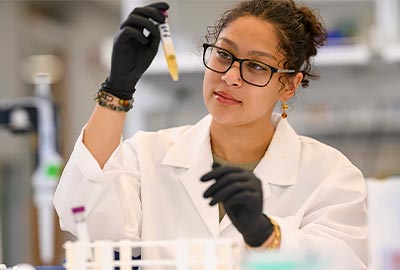
“Science is not done in a bubble,” she said. “You have to collaborate with others, and through that collaboration you gain and learn so much more. This is a really solid group of students who are all working on the project together. Their diverse majors give them different perspectives to help them understand how this organism causes this disease. AbbeyLynn knows the animal science of it; Jazmine comes at it from a biochemistry standpoint; and Rae’s biology training allows her to look at it from the disease and bacterial standpoint. All those perspectives give them different understandings of different aspects of the research, and they learn a lot by talking about it together.”
As this issue goes to press, the students and their faculty mentors are beginning work on a paper to share the knowledge successfully presented on campus last spring with the wider scientific community. Each step in the process has built skills that will help these students determine their own path academically and professionally.
“I like helping students figure out if research is what they want or not,” Rhodes concluded. “If they do figure out they love it, we are committed to giving them as real an experience as possible from writing a grant application to having their names on a paper. I love seeing them discover this whole new avenue of life they didn’t realize was possible.”
Investing in curiosity
While the horse strangles project has helped prepare a succession of Berry graduates for doctoral-level research and study, it is far from the only such story on campus.
For example, Faith Pennino (26C) graduated in May with a psychology degree and four peer-reviewed journal publications to her name, the result of close collaborative research with two Berry professors. She is continuing her studies as a Ph.D. student in cognitive neuroscience at Texas A&M University.
“For Faith to be that productive is impressive,” said Dr. Kristen Diliberto-Macaluso, Berry’s director of undergraduate research and professor of psychology. “Four journal publications is more than many people have coming out of graduate school.”

She added that more than 200 Berry students were engaged in projects flowing through the Office of Undergraduate Research in the last academic year. The total number of undergraduate researchers across campus is even higher, with Diliberto-Macaluso noting that students in almost every academic department are gaining significant value through such activity.
“Berry students have the opportunity to work closely with faculty beyond the classroom to investigate questions that are interesting to them,” she explained. “They’re creating new knowledge, whether that’s launching new programs in their respective fields, learning new techniques in the fine arts or publishing in academic journals. In every case, students enhance practical skills like creative thought and communication. They learn how to organize their work and share it through oral or poster presentations. All these experiences improve their confidence and independence as scholars.”
Making such opportunities possible is one way Berry ensures that its education of the head, heart and hands remains distinctive and relevant. Examples are abundant:
- Through LifeWorks, many students secure paid on-campus research positions.
- Internal grants available through the Office of Undergraduate Research – some made possible through gifts from alumni and friends – help students pay for conference travel and research costs. Just this spring, such funding enabled nursing major Miriam Miller Hughes (26C) and economics major Susie Peters (26C) to travel to Washington, D.C., to present at the National Council on Undergraduate Research. Other grants offset travel costs for students selected to present at the 2026 Posters at the Capitol event in Atlanta.
- This summer, 73 students were mentored by 25 faculty members through the college’s Summer Undergraduate Research Fellowship program, an increase in participation by both undergraduates and mentors.
- The annual Symposium on Student Scholarship drew more than 178 student presenters last spring; in addition, Berry hosted its first Conference on Student Research and Creativity in fall 2025, welcoming students and faculty from four other institutions.
“These experiences allow students to really contribute as scholars,” Diliberto-Macaluso declared, “whether that’s adding to the body of knowledge or making a difference in their communities.”