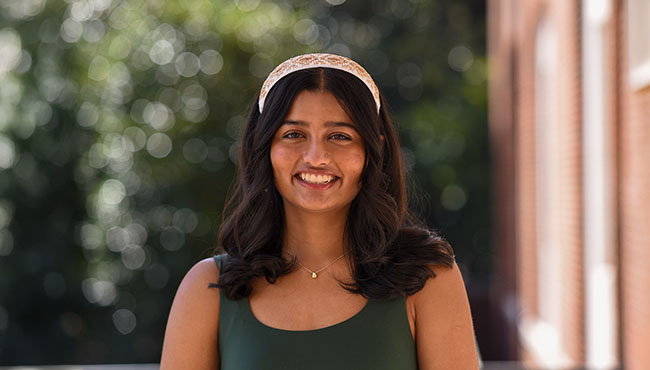
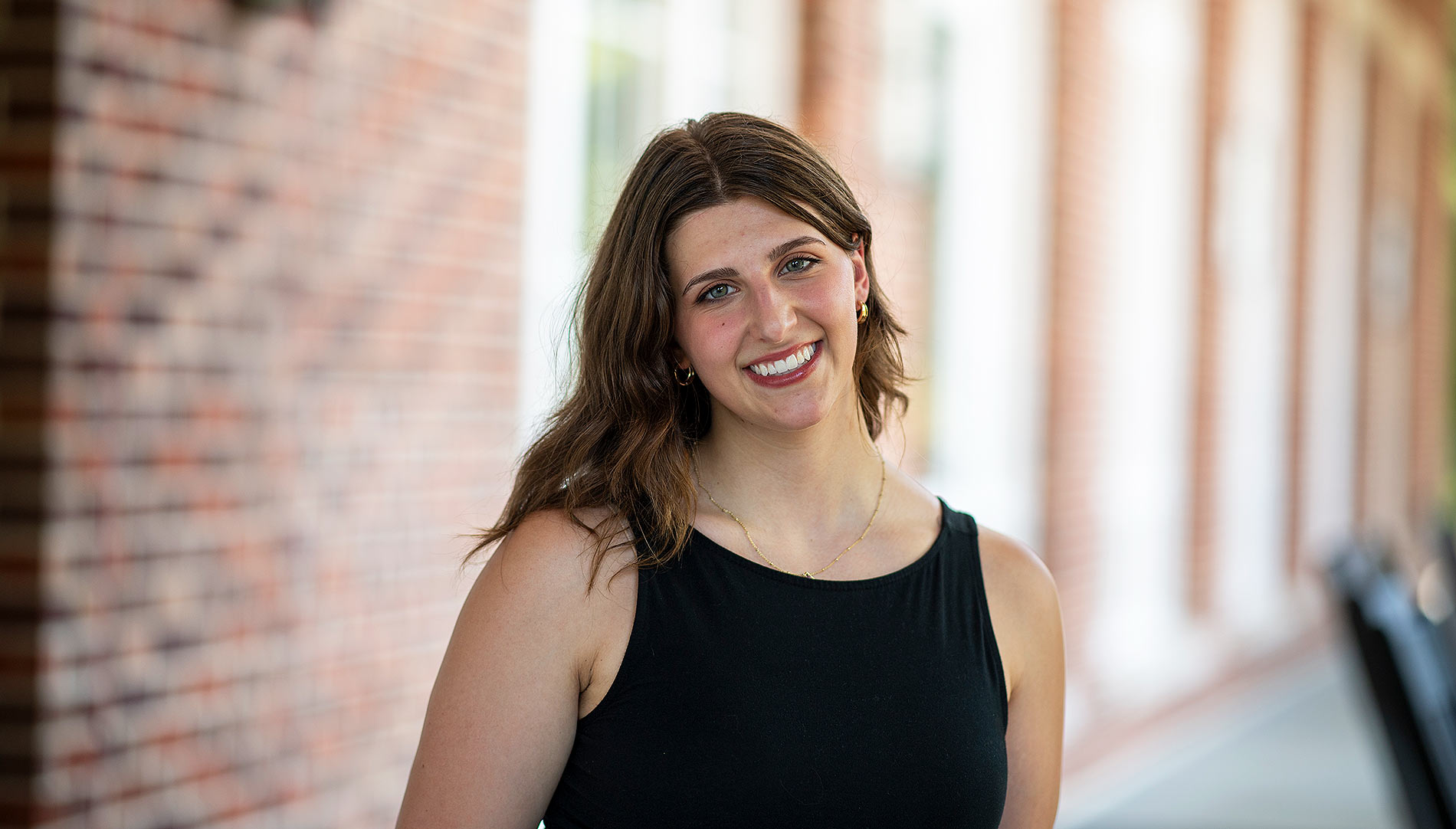
Faith arrived at Berry to pursue a counseling career. But with a background in art, she decided to research the connection between neuroscience and creativity. Now she’s headed to Texas A&M University to pursue a Ph.D. in cognitive neuroscience.
“I’ve always been curious about how people think and how they experience art,” Faith explains. “But I didn’t realize research could be such a creative outlet until I got here.”
The effect of art on attention
Faith attended the Alabama School of Fine Arts, where she worked across mediums. She discovered how color, contrast and perception shape the way people interact with artwork. Her early fascination resurfaced during a research methods course at Berry.
“I thought about the color‑contrast comment an art teacher had made,” says Faith. “I wondered if her thinking about contrasting colors was true. Does contrast pull our attention?”
Encouraged by faculty, she designed and coded a project exploring how people respond to visual distractions. Berry’s Ralph George Scholars Fund and Summer Undergraduate Research Fellowship supported her work. Findings showed that color contrast interrupts focus. Later results revealed that people can learn to suppress those distractions over time. She presented her research at the international Psychonomic Society conference in Denver.
Building leadership skills
Faith thrived in Assistant Professor of Psychology Kuo Deng’s lab. She worked on studies involving meditation interventions and the experiences of Asian Americans in the South. Leadership roles in this environment helped her realize she loves guiding others.
To broaden opportunities for students interested in the brain, Faith founded Berry’s Neuroscience Association. The organization runs hands‑on demos, brings speakers to campus and helps students explore emerging topics.
At Texas A&M University, Faith will work in Professor Brian Anderson’s attention and perception lab. “I’d love to lead my own lab one day,” she says. “Research lets me use my creativity in a scientific space.”