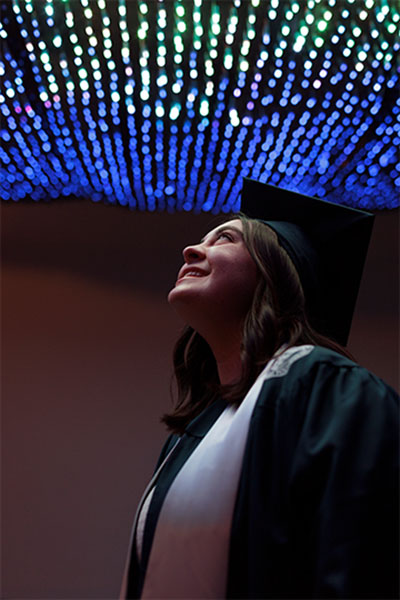
Ansley Reed ’26 will pursue a Master of Divinity degree at Samford University this fall, with plans to serve as a hospital chaplain. Integrating majors in religion and philosophy and creative technologies challenged her to dive into humanity’s role in technology. The dizzying speed of artificial intelligence (AI) developments at the expense of ethical considerations inspired Ansley’s Honors thesis.
Making ethics central to AI
Building on Pope Francis’s contention that the goal of “technological innovation should be the flourishing of all humans,” she notes that society has detached its innovation from its ethics. Ansley analyzes three common uses of AI — search-based tools like Google, emotional or companion-based use, and work-based solutions. Then she draws on three principles (justice, stewardship and human capacity) to propose a framework “for engaging AI in a way that supports human flourishing and the good of the people and the world around us.”
Ansley says, “I am especially interested in helping people understand the science behind the technology they interact with so they can make more informed and intentional decisions.”
The power of liberal arts in the 21st century
A liberal arts foundation proves as relevant today as in previous centuries. “It is often suggested that there is a choice between technical expertise and moral or human formation,” she observes. “But I do not think it holds up as a real divide. Instead, the more helpful approach is an integrated one that brings both together, allowing for more thoughtful, responsible and well-rounded human development.”
Concern for people is at the heart of Ansley’s endeavors. Her experience as a caregiver for a family member drove her to create a portfolio of projects focused on assistive technology geared for individuals with diverse abilities. Her goal was to enhance their quality of life and foster happiness and fulfillment.
“I get excited about the way creative technologies teaches students to embrace failure and use it as a driver for innovation,” she reflects. “The program has really found a way to support strong student outcomes while keeping students engaged in work that is rooted in their passions and meaningful interests.”