- Automotive technology
- Cosmetology
- Carpentry
- Plumbing
- Electrical work
- Welding
- Heating, ventilation and air-conditioning (HVAC)
It’s no secret that the next generation of young people is faced with shifting technologies and a rollercoaster economy. Because of this uncertainty, many students are rethinking the traditional college path. The allure of concrete skills, a clear job track and cold, hard cash earned fast has never been more enticing. Now, many high school graduates are wondering, “Is college still the best route? Would at trade school be a better choice for me?”
As a college, we believe in the value of the four-year experience, but not just because we offer it. We have seen firsthand how four-year guided experiences like the Berry Journey transform students’ lives. So, maybe a better question is, “Why do we believe our model is the best choice for a lot of students?”
This guide will help readers tally the pros and cons of a college vs. trade school experience and offer them direction for their next steps.
Defining the differences
A trade school, sometimes called a vocational or technical school, prepares students with a set of skills and expertise for a specific career field. When completed, students receive a certification that is often required for a job in that field. Here is a list of common focus areas found at a trade school:
- Culinary arts
- Graphic design
- Coding
- Dental hygiene
- Pharmacy technician
- Veterinary assistant
- Construction
Trade school pros
The general argument for attending a trade school is that it requires less investment in the short term. Trade schools can cost less money up front than a college degree and may require a shorter time commitment. Less time and less money mean less debt for some. Others appreciate the ability to enter the working world sooner, earning a regular salary more quickly than some who attend college.
For those students who loved shop class in high school and disliked the more abstract or theoretical discussions, trade school also might be a good fit. If you love working with your hands and can see yourself doing similar work for the long haul, trade school could have its benefits. But it is important to recognize that many trade jobs are physically demanding and may also require accepting certain on-the-job risks.
Trade school and AI
Others have argued that artificial intelligence (AI) is less likely to take over blue-collar jobs. With this thought driving educational choice, some believe trade school to be “the path of least replacement.” To some extent, there’s truth in the fact that AI has been slower to adapt to tasks that require dexterity and mobility in messy environments, such as plumbing.
However, it does not mean that blue-collar jobs are safe from being replaced by AI. Just think about the AI already in use in homes — HVAC systems that come with predictive diagnostics or cleaning robots, for example. AI is likely to affect all areas of work in the future. So, rather than asking, “Will I be replaced?” students should ask, “Which education will prepare me best for an AI future?”
Why college
What makes it worth the time and investment? Here are a few pros for the college column.
You develop self-awareness on the path to career development
Not every student arrives at college knowing exactly what they want to do, and that’s okay! The college experience, especially at schools like Berry, is designed to help students explore options. Through personality assessments, advising sessions and exposure to a range of disciplines, students like you get a better sense of a future career before diving in headlong. Then, reflecting on what you learn helps you set goals rooted in your strengths and values so you can design a future that’s right for you.
Employers increasingly value graduates who take a proactive approach to their career trajectory. They look for individuals who are self-aware, eager to grow and capable of building strong relationships within and beyond their organizations. These qualities are often nurtured in the college environment through this exploration. In fact, companies today are asking, “What can we automate with AI in order to free up employees for stronger human interactions in specific spaces?” Self-awareness is a powerful piece of being flexible in the future.
You gain a comprehensive set of skills
According to recent U.S. BUREAU OF LABOR STATISTICS (BLS), the average American worker has been at their job for just under four years. In the last ten years, average job tenure shortened for all age groups 25 and older. In other words, people are just not staying in their jobs as long.
Many Gen Z workers say they are job-hopping by choice. They want meaningful jobs that will help them grow. Whether by choice or by change, having a transferable and comprehensive set of skills is invaluable in today’s job market.
One of the best models of this type of graduate is known as the T-shaped graduate. This type of student or individual has deep expertise in a certain area (the vertical bar of the “T”) and comprehensive knowledge across disciplines (the horizontal bar).
A T-shaped graduate is especially valuable in today’s workforce, where interdisciplinary thinking and collaboration are key. Strong communication skills. For example, a T-shaped graduate might major in creative technologies and art and end up as an architect.
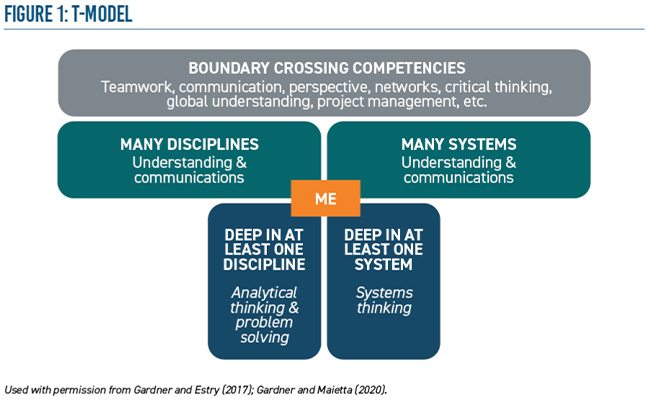
Maietta, H. N., & Gardner, P. D. (2023, May 10). The ever-fluctuating skill set: The college-to-career transition and the T-student. National Association of Colleges and Employers.
You learn to learn and become adaptable
Today, adaptability in the working world is essential. While memorizing facts and following certain instructions are foundational skills, employers need people who can assess a situation, think critically and respond with thoughtful solutions.
College students, especially those at schools that emphasize comprehensive education, are trained to use higher-order thinking skills as a part of the core curriculum. They don’t just learn content; they learn to compare, apply, connect and synthesize ideas across disciplines. This kind of intellectual adaptability prepares students to be lifelong learners, capable of evolving within their field and staying ahead of technological shifts.
You experience joining a community
We are not making the typical “best four years of your life” argument, but the social and support structures of a traditional college are significantly different from those of a trade school. Although some have added housing and tried to change this stereotype, the number of people invested in your future at a college, especially one like Berry, is just different.
Not only will you build relationships in your classes, but there are more clubs, panels and resources in general for connection. Colleges offer a wide range of extracurriculars, leadership opportunities and service experiences to help students grow personally and professionally. Education is about becoming a well-rounded individual.
Likewise, there are more mentors and advisors ready to guide and connect you in your specific area of focus. Beyond on-campus resources, colleges are connected to their alumni and the communities where they reside. The number of people invested in your future when you graduate — from faculty and advisors to alumni and community partners — is substantial. And these connections often lead to opportunities, guidance and a sense of belonging that lasts beyond graduation.
Common misconceptions
Small class sizes
Some trade schools suggest a benefit is their smaller class sizes, but not all colleges are full of giant lecture halls. You don’t have to rule out college if you're looking for a close-knit learning community. Smaller institutions like Berry often maintain a student-to-faculty ratio closer to 12:1, allowing for personalized attention, mentorship and meaningful classroom discussions.
Real-world experience
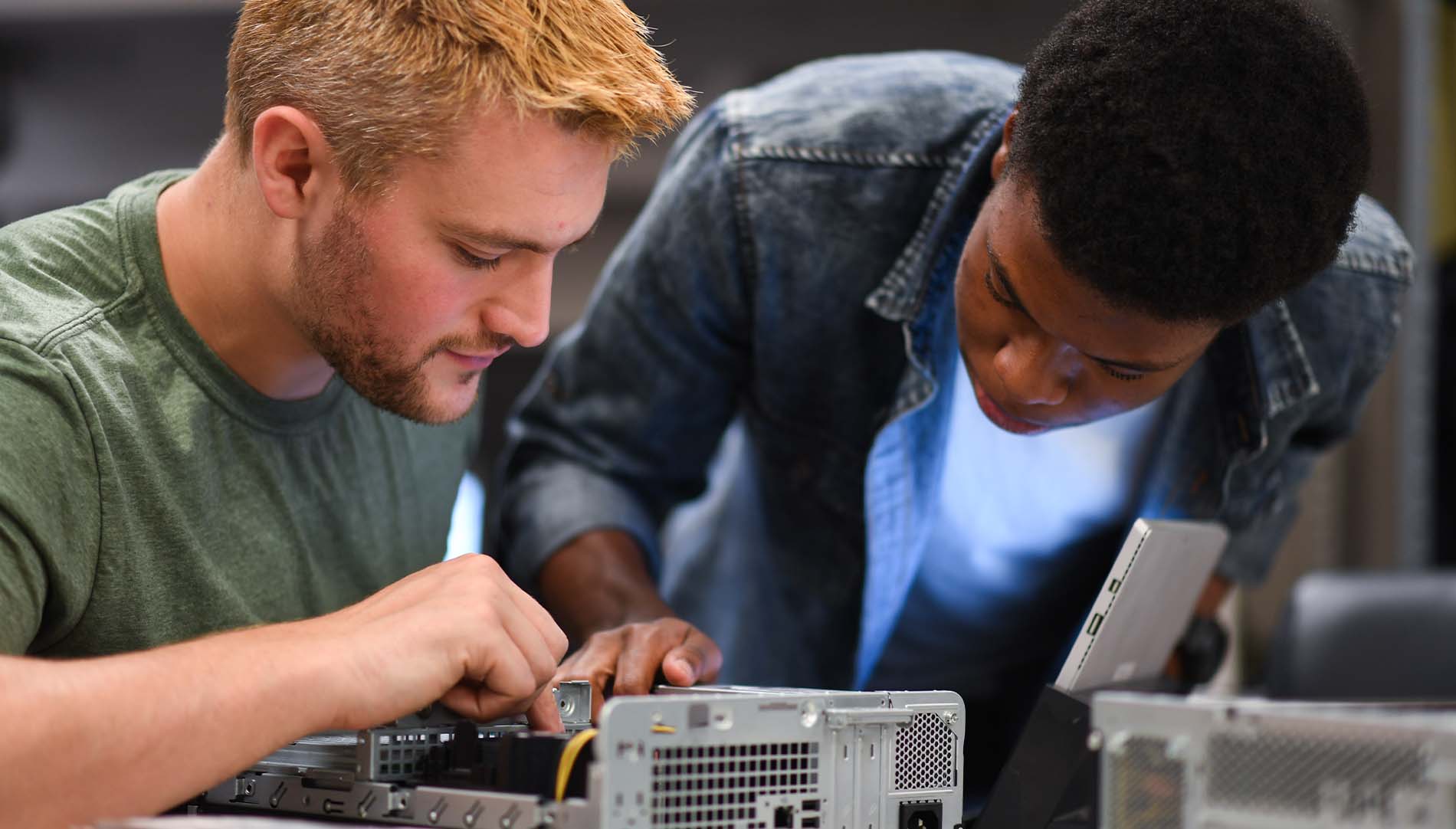
Many trade schools emphasize that they are the place to get practical experience. But at colleges like Berry, we are equally committed to hands-on, real-world application as we are to work in the classroom.
Through our signature experiences, students apply classroom learning in real-life settings. Whether it’s a campus job, a research project, an internship or a community-based initiative, students get to apply their learning, “try on” their future career and build a portfolio of experience before they graduate.
Like to work with your hands? Good! It's in our mission that we are not just about educating the mind, but the heart and hands as well. We are a campus where students have built a significant portion of the buildings. It’s a historic piece of our founding that makes us distinct. Visitors to campus might see students painting fences, tending sheep or collecting stream water for testing. In fact, many pre-med students claim their favorite job on campus while studying for the MCAT is the grounds crew. At Berry, there’s no shortage of real-world opportunity.
Take some steps to decide trade or college
- Think beyond your first job. Research job prospects and earning potential in the fields and trades you are considering. Ask yourself, “Will I always want to be the worker bee or do I aspire to be the boss?”
- Compare the “true” cost of the colleges and trade schools you’re looking into. Then compare the cost to your future earning potential in that field.
- Consider your learning style and interests. Think through which educational option might be the best fit.
- Visit campuses and programs. Experiencing an environment can help you get a sense of whether you belong.
Final thoughts
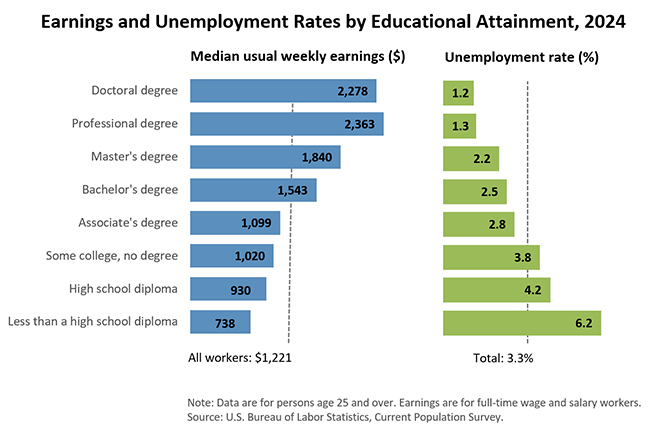
Today, the U.S. BLS still reports that higher levels of educational attainment equal higher earnings. So, why not consider an education that offers to educate the head, heart and hands. The toolbelt generation is welcome here!
With Berry College’s unique mission, we are not just focused on classroom theory. Serving and working is something we really value.
Come design a life at Berry, identifying your academic, personal and professional goals for the future. The outcome? Graduates leave equipped with an impressive collection of skills and practical experiences, a sense of where they're headed and a better understanding of the person, citizen and community member they want to become. Visit today!