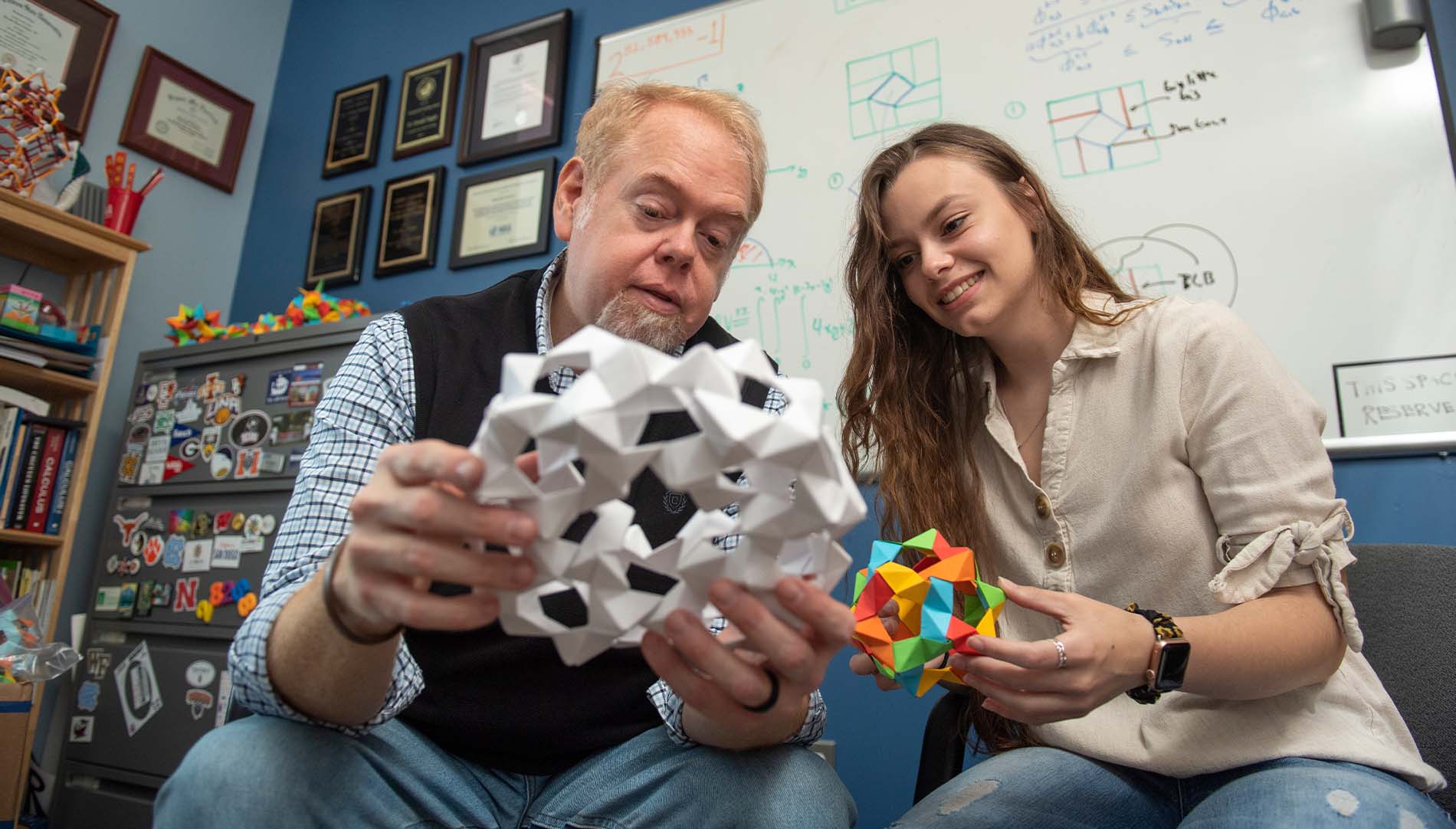
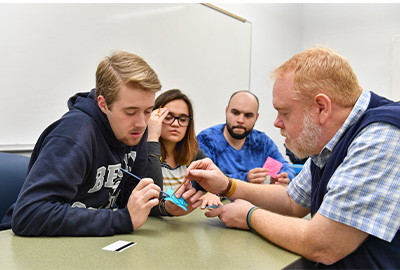
“While I am interested in the math of origami,” says Taylor, “what I do most often in class is teaching math concepts with origami.”
Taylor gives the example of teaching his classes about fractals, infinitely complex patterns that are self-similar or look the same at different scales. But in Taylor’s classes, students actually fold an approximation of a fractal themselves as they learn about them.
“They come away with something cool and beautiful. They learn a new recreational skill that is fun, challenging and restful, and, of course, they leave the class with a concrete example of their learning,” explains Taylor.
Origami and math in the real world
Using origami to teach these abstract concepts, Taylor also helps students identify other examples in use. For example, he points out that some of the origami techniques are used in engineering, robotics and other places.
“Telescopes and solar panels, for example, both apply origami folding techniques in their design. Medical devices like stents, gene therapy or other surgical tools that unfold inside the body also use origami folding methods. It’s exciting to see where they find other examples, and students really appreciate seeing that some of the first models of these folding technologies were made of paper,” says Taylor.
One question Taylor seems to get frequently is how he discovered recreational math. Although his story is full of conferences and math influences, at the heart of his academic journey was the freedom to be curious, an idea he shares with his advisees.
“When advising, I remind students that if they don’t leave any room for discovery, if they come to college with a set plan, they might miss all the interesting ways to apply or use a field of study,” says Taylor, “When I’m in a math class and can see a student’s wheels turning, I encourage students saying if they have these questions, they should consider following their curiosity to deeper levels of math. Leave room for the unexpected learning and see where math can take you.”
Curiosity to career
Taylor cites Dillon Yost ’14 as an example of a student who thought he was headed into chemistry also loved his math classes. Listening to his interests, Taylor and another faculty member encouraged him toward research that combined his curiosities. He could run computer simulations on molecules using the principles of physics. Little did he know, these professors were introducing him to research that would lead to post-doctoral work at MIT, then NASA and finally the Lawrence Livermore National Laboratory in California.
At Berry College, the Berry Journey curricular approach is designed to help students understand what matters most to them and bring focus when considering the possibilities for planning a future. They don't just pick majors; they set goals rooted in their strengths, interests and values, working with trusted mentors to identify a set of learning opportunities aligned with academic, personal and professional goals.
In a world where knowledge is increasingly interdisciplinary and innovation demands creativity, hands-on learning is more than a teaching method. It’s a mindset. Whether through folding paper to explore fractals or discovering unexpected career paths through curiosity-driven research, students are empowered to connect theory with practice. And in doing so, they leave Berry not only with knowledge but also with the confidence to apply it in meaningful, unexpected ways.
Want to visit Berry or learn more? Find all you need to know about Berry College here!