For more than a century, the American chestnut, once a dominant tree across eastern North American forests, has been devastated by an invasive fungal disease that killed billions of trees in the early 1900s. A new study published in Science shows that modern genomic tools can dramatically accelerate restoration while preserving the species’ ecological identity.
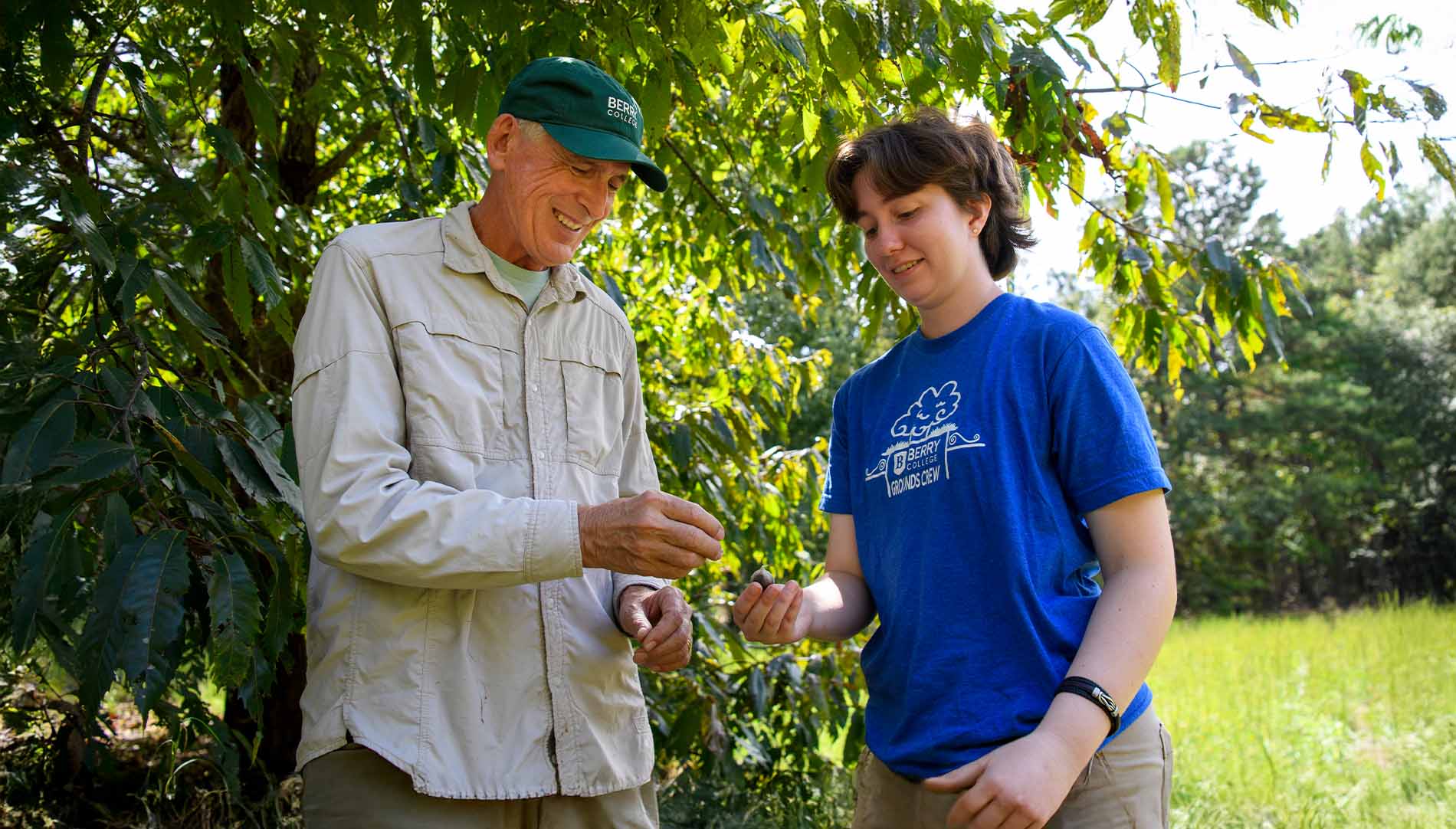
Breeding lines, experimental protocols, and data critical to the analyses included in this paper were generated at Berry College by Biology Professor Emeritus Martin Cipollini, assisted by Associate Biology Professor Caitlin Conn, and many Berry undergraduate students as well as Georgia Chapter of The American Chestnut Foundation volunteers.
“With genome-enabled breeding, we expect the next generation of trees to have roughly twice the average blight resistance of our current population, with about 75 percent American chestnut ancestry,” said lead author Jared Westbrook, The American Chestnut Foundation’s director of science. “These trees are expected to begin producing large quantities of seed for restoration within the next decade.”
The research demonstrates that genomic selection, a method widely used in agriculture and animal breeding, can predict disease resistance in chestnut trees using DNA data alone. By allowing breeders to identify promising seedlings before years of field testing, the approach shortens breeding cycles, a critical advantage for a tree species that takes years to reach reproductive maturity.
The implications extend beyond the American chestnut. Researchers say this approach offers a model for restoring threatened tree species worldwide, demonstrating that conservation can operate with the discipline of a breeding program and the patience of a forest.
Generations of scientists and volunteers have worked to breed American chestnuts with Asian relatives that naturally resist the fungus. The central challenge has been balancing beneficial traits: Asian chestnuts evolved alongside the fungus and carry natural resistance but tend to grow shorter. American chestnuts grow tall and fast — traits critical to their role in forest ecosystems — but remain highly susceptible to blight.
By combining genomic sequence data with long-term blight resistance data among thousands of hybrid chestnut trees from The American Chestnut Foundation’s breeding population, researchers from the foundation and Virginia Tech showed that resistance can be reliably predicted from genetic data. This enables the Foundation’s breeding program to retain high American chestnut ancestry while steadily improving blight resistance.
The study also examined rare wild American chestnuts that have survived decades of infection. While some pass on modest resistance, more work is needed to determine if these rare survivors have the levels of resistance and adaptive potential required to restore the species.
Researchers additionally evaluated genetically modified chestnut trees designed to neutralize a toxin produced by the fungus. Although promising in early greenhouse tests, field trials revealed variable resistance and slower growth compared to non-modified trees, underscoring the biological complexity of disease resistance.
To understand why Asian chestnuts resist the disease so effectively, researchers at the Hudson Alpha Institute for Biotechnology assembled some of the most complete chestnut genomes to date. Resistance emerged as a genetically complex trait involving many genes working together, rather than a single genetic switch. Furthermore, Oak Ridge National Laboratory researchers discovered that disease-resistant Chinese chestnuts contained chemical compounds that reduced or stopped the growth of the blight fungus.
With this complex array of resistance mechanisms, the researchers concluded that multiple generations of breeding and selection of the most resistant and tallest growing trees is necessary to develop populations suitable for restoration.
“Chestnut restoration is a long-term compounding process,” said the foundation’s President and CEO Michael Goergen. “Each generation becomes stronger and better adapted. Genomic tools allow us to build a restoration pipeline that keeps improving over time.”
Rather than focusing on a one-time rescue effort, the framework established in this study emphasizes endurance. Genomic restoration enables continuous improvement across generations — a shift from preservation toward ecological resilience.
The implications extend beyond the American chestnut. Researchers say this approach offers a model for restoring threatened tree species worldwide, demonstrating that conservation can operate with the discipline of a breeding program and the patience of a forest.
Cipollini is the current president and science coordinator for the Georgia Chapter of The American Chestnut Foundation and is a member of the national Board of Directors. Cipollini has been involved in chestnut restoration work at Berry for about 20 years. The main chestnut research orchard is located just west of Berry’s historic Old Mill and was established in 2007.
Berry College students, now alums, who supported this work:
- Henry Antrobus
- Natalie Bailey
- Tristan Christensen
- Lilly Dunn
- Cooper Foster
- Aurora (Hampton) Setias
- Noah Howie
- Shanna Lee
- Marshall Lynch
- Gavin McClellan
- John Patten Moss
- Hali Reece
- Anna Rose
- Mitchell Ryder
- William Walker
- Morgan Wingo
- Eden Young